Blumler and Katz: Uses and gratification
The study of uses and gratification by Blumler and Katz is the study of why people buy things how they gain gratification from them. They categorize their study into four concepts:
'Escapism' the idea that we use books, movies and other forms of media such as Role playing games, to escape the reality of the real world. Secondly 'Personal Relationship' the idea that a relationship is developed with the fictional characters and the receivers. 'Personal identity' is the concept that the receivers' identity is influenced by the fiction characters such as the impact of a role model. Lastly the concept of 'surveillance' this is gaining an understanding of reality through these medias, however certain medias can lead to a distorted view for example watching biased news stations.
Tuesday, 21 April 2015

Friday, 17 April 2015
Hypodermic Needle Theory
E.D Martin's: Hypodermic Needle Theory
Martin's addresses the impact of media on society. As a hypodermic needle would the media has the ability to have a direct and immediate influence on its audience. Martin explains that we can not choose to filter what we are exposed too; it is a form of propaganda. The fashion industry is a key example of how the Hypodermic needle theory works, the clothes the advertise influence the clothing of society and what we see as fashionable.
Martin's addresses the impact of media on society. As a hypodermic needle would the media has the ability to have a direct and immediate influence on its audience. Martin explains that we can not choose to filter what we are exposed too; it is a form of propaganda. The fashion industry is a key example of how the Hypodermic needle theory works, the clothes the advertise influence the clothing of society and what we see as fashionable.
Wednesday, 10 December 2014
Poverty Porn
I disagree with the
concept of poverty porn TV. i believe that it exploits those in harsh
conditions with false expectations of an improved lifestyle as a result of
participation in the shows, they are filmed for a pure entertainment factor and
are represented in the worst way the use of footage editing highlights the
extreme and worsts aspects of their lives, this diminishes the true reality of
their financial and economic situation. The target audiences for shows such as
SKINT and Benefit Street are those who can relate to the stars in the shows
e.g. lower classes or those in financial poverty situations and those of middle
class background who sum up the rest of the viewership for channel 4. I believe
that those from more moderate backgrounds watch poverty porn TV for a sense of
entertainment to see how the rest of Britain live and how these almost
'fictitious' characters deal with their lives and struggles. Despite the
programming being presented in a somewhat informative manner to educate the
viewership on the other half of the British population's hardships, i believe
that this is just a method of self-censorship to conceal the lack of moral
concern for those depicted in the programs. Clear exploitation is apparent;
dragging the concept of an informative program over multiple seasons and
episodes weakening the message; turning the concept of poverty porn in to a
method of entertainment for TV consumption.
Further evidence of the entertainment factor is the use of editing
the footage. This allows editors to pick and choice aspects and events within
the lives of those in the show to glamorize their misfortunes. As a view i
share no similarities with those in the show therefore I cannot relate to their
struggles the show only fulfils my gratefulness of my own live, some may take
the show and look down upon those on SKINT or benefit street.
Wednesday, 26 November 2014
Posh People: Tatler problems
Tatler magazine and the Posh lifestyle
Tatler is a glossy fashion and lifestyle magazine that has been in circulation since the 18th century. Tatler is a 'go to' for the upper classes, whether it is finding fashion advice for the changing seasons or latest gossip on the rich and famous of Britain. However despite its huge national readership it faces many issues on how it defines its views on culture and class systems' within Britain and the UK. After viewing the BBC 'fly on the wall' documentary 'Posh People: Inside Tatler’ it is clear how the editors, journalists and staff of the publication are defined by their culture, education and class. Tatler only focuses its importance of the rich and famous of the upper classes. This shows not only in what they write and publish but even in the staff in which they hire; Tatler deems importance on social status and it pushed on their employees, who come from the poshest boarding schools, the highest education and most privileged background. However those who lack in the adequacy of the company are given a complimentary guide to etiquette and modern manners handbook to revise. This demand of their employees most certainly influences the content of the magazine. Throughout the Documentary there is an underlining theme of improvement, especially for those who are not quite up to the highest standard of Tatler, they define themselves as the "gatekeeper of the upper class" the 21st century sees a more broader audiences for Tatler it is no longer just for the social elites. As a result Tatler sees this as their responsibility to improve the readership. They feature guides and tips on how you can tweak your identity through fashion advice and matrix's on People and objects you should surround yourself with to appear to be of a higher class. Furthermore the journalism that is carried out on the ‘non-posh’ lifestyle is abundant. There is a part within the documentary where a journalist is sent out to a local Poundland, she is shocked by the content in which you can purchase for £1, this highlights the lack of integration between of class systems at Tatler and how those of lower status acquire a certain stereotype by the ‘posh’. However this integration and lack of communication of class systems doesn’t just define Tatler it also representative of the majority of the upper class society, as portrayed by the documentary. Additionally despite integration of different Race ethnicities there is still stereotypes drawn by upper classes for example in the case of Kola Karim shown by the BBC as a Nigerian millionaire living in West- London, he made his fortune through African oil trades and construction companies however is still questioned by many how he obtained his money many assume due to the colour of his skin he is a sports star or athlete. These generalisations and stereotypes are created from the segregation, miscommunication and false representation of society, which is stirred and fuelled from publications such as Tatler who are reluctant to leave their ‘posh bubble’.
http://www.bbc.co.uk/iplayer/episode/b04q0wwg/posh-people-inside-tatler-episode-1
Wednesday, 19 November 2014
Non verbal communication
TED TALK: Amy Cuddy
Amy cuddy a social
psychologist who speaks on her research on how our nonverbal behaviour affects
our lives in more ways in which we initially realise. Also on how minor tweaks
can benefit our perspective and behaviour towards life essentials, such as
work. Nonverbal’s can influence how others judge us and how we judge others for
example an individual with poor posture and who avoids eye contact can be
judged negatively as someone who is lazy or lacks interest. Secondly our own
body language influences our perspective towards life and our physiology.
She believes that choosing to adopt a more positive attitude towards nonverbal
commination or “faking it” can help us progress and improve our own
self-esteem while motivating us. She claims that there are two different types
of attitudes towards body language: High
Power and Low Power. People
who adopt a higher power are more involved in discussions, more
upbeat, more motivated and tend to have higher success rates. While in contrast
people who adopt a lower power are more reserved, less confident,
less involved and tend to not succeed at a higher rate than those with a higher power attitude. She has identified
the different ways in which people communicate what type of power they fall
under, through the study of Kinesics (body movement) these ways of
communication can consist of :
· Gestures
· Facial expressions
· Body Posture
· Body Movement (nods, shrugs..etc.)
Sunday, 9 November 2014
Sub-cultures: MODS
https://www.facebook.com/video.php?v=717995938279225&pnref=story
Fred Perry's short documentary clip on the evolution of the British Mod sub-culture group, with influences of music, fashion and current affairs spanning the late 1950's up until the early 1970's
Fred Perry's short documentary clip on the evolution of the British Mod sub-culture group, with influences of music, fashion and current affairs spanning the late 1950's up until the early 1970's
Wednesday, 5 November 2014
Seven Concepts
Key Concepts in Comms. (Communtication &
Culture)
Communication: a
process through which meanings are exchanged.
Context: the
situation within which communication takes place.
Culture: a
particular way of life which expresses certain meanings and values.
Identity: the
sense we have of ourselves, which we then ‘represent’ ‘elsewhere’: a
person’s social
meaning.
Power: control
and influence over other people and their actions.
Representation: refers
to the construction in any medium (especially the mass
media) of aspects of
‘reality’ such as people, places, objects, events, cultural
identities and other
abstract concepts. Such representations may be in speech or
writing as well as
still or moving pictures. (Daniel Chandler’s definition).
Value: the worth,
importance, or usefulness of something to somebody.
Sub-Cultural groups are sensitive to contemporary trends in fashion,style and music.
A sub-culture group is
a group of individuals who interact socially with each other and who are
recognisable to outsiders as being a part of a group, for example ‘punks’ are a
western sub-culture group that have evolved from the punk rock music genre. A
‘punks’ syntagm collectively is stereotypically rebellious and
anti-establishment, outsiders can identify this through signifiers such as: rough/baggy
clothes, shaved or spiked hair styles and usually an abundance of piercings.
All groups consist of individuals with individual needs. Certain needs can be fulfilled within a social group.
All groups consist of individuals with individual needs. Certain needs can be fulfilled within a social group.
The ‘punk’ genre is
distinguished as it can fulfil multiple needs for an individual especially as
adolescence, this is the period in which we grow socially and begin to
associate ourselves with others while trying to rebel and break away from the
elder authoritarianism life style. For example we look for trends within our
needs such as in fashion, music and style and look to satisfy these needs when
joining a group. Those who associate themselves with a sub-culture group can
achieve a sense of belonging and loyalty from joining which in effect can boost
an individual’s self-esteem when expressing aspects of their identity around
those who share similarities. As spoken by Nicholson “we as people are
attracted to those who share common interests”, these similarities can evolve
and are contemporary to trends. Trends are significant when identifying groups
they also act as a barrier between groups isolating them from each other each.
However as the dawn of technology has took grasp on society it has become
harder to distinguish social groups in public situations especially within
teenage groups like socially and being active tend to take place online.
As teenagers we strive
to be socially accepted, however culture groups establish themselves on a set
of culture codes these codes can vary between culture-groups they tend to focus
around solidarity of the group. The punk ideology is cantered around not caring
for authority and regularly socially at venues such as music events.
Wednesday, 8 October 2014
Semiotics: Analysis Of Movie Posters
Semiotics is the study
of signs and symbols, all posters use semiotics to communicate with the public
and their audiences. Communication is composed of three aspects “Sender”
(someone who is trying to address a message or initiate communication), the “message”
(the subject of communication; what the sender is communicating to others) and
“receiver” (the person who accepts the message and interprets what is being
communicated). For example Movie posters use a set of imagery and symbols
known as paradigm to convey the message of their film to the audiences. Signs
all have different connotations, the connotation is the implied meaning behind
the sign collectively a set of signs are more commonly known as a “syntagm”
connotations of signs can vary between cultures. Movie posters use signs to
create a syntagm for their movie, movie posters use more closed text compared
to more open text posters; the term “open and closed text” was coined by
Umberto Eco, open text leave more to the receivers imagination these are more
abstract texts and can be interpreted in multiple ways unlike closed texts that
have only one message.
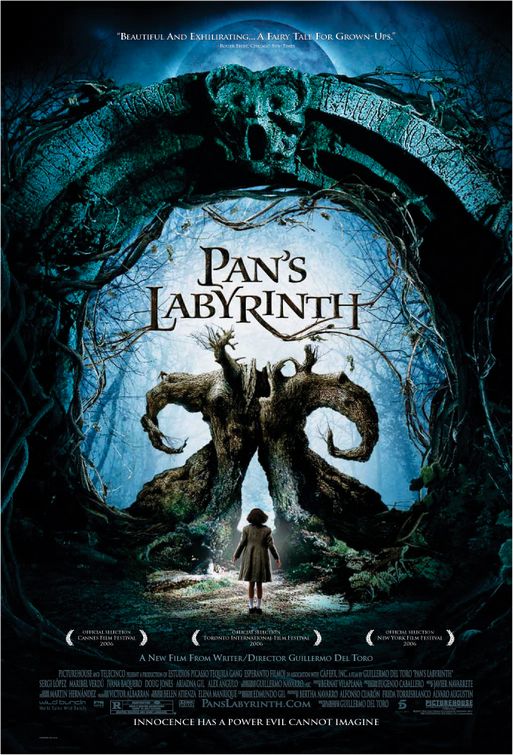
Multiple signs and
symbols can be found in movie posters we use these interpret the genre and the
style of the movie. This movie poster has:
A young girl,
connotations of this can be youth, purity and peace.
A Dead tree which has
connotations of death, decay, neglect.
Night time setting
which signifies horror, fear, lost, absence.
Gothic stoneworking
usually has connotations of the horror genre.
The poster’s use of
signs creates an idea of its message for example little girl leads us to
believe that this movie is a children’s film due to its associations with
purity and vulnerability however her positioning in the poster hints us to
believe she is lost or she is somewhere she shouldn’t be. The scenery
reinforces this idea the dead trees and dark weather links to a horror genre or
a place that has connotations of unhappiness and dismay. The lighting in the
middle of the poster is seen to be enticing and alluring however due to the
message given off from the scenery it leads us to believe that danger is
lurking, the message of the poster can be signified as a horror or dark film.
Monday, 6 October 2014
Selfies
Selfie is the term
given to a self-portrait photo taken on a mobile phone of one’s self. Selfies
have become more mainstream in the last 5 years as the modernization of mobile
phone technology has skyrocketed. Millions of selfies have been uploaded to
online social media, the internet and mobile social apps. Selfies have become a
craze and have each have their own category some such as: Car selfie,
"just woke up" selfie, Duck face selfie, Gym selfie, etc... The
purpose of a selfie from the senders perspective is to depict them self in a
desirable manner, this could be through jealously, wealth or attractiveness.
The sender most commonly depicts their most cynical identity this is to promote
themselves to friends or even strangers, the sender tends to use their most
cynical personality 'whether this is a photo where they look most attractive
compared to previous photos' to boost their own self esteem. This is usually to
appeal to what we deem as socially desirable or attractive. Boosting their self-esteem
makes them feel happier about themselves as a person and they will also tend to
seek reassurance of this message from others, most likely through comments or feedback
on their selfies. The message the sender is trying to send is usually one of
envy, selfies tend to have the effect of envy on the receiver who views it. However
what they are viewing isn't always a true representation of the senders’ true
identity,
Top 15 Selfies
Wednesday, 1 October 2014
Women in media
Objectification of
women in media
The media’s
representation of women in our modern patriarchal society constantly objectives
and extorts the female image for advertising gains and to increase the
popularity for branded items and products.
The use of women as a
method of increasing marketing and sales for production is used in excess,
especially in cultures such as the western world (America and Europe). One of
the main purposes of the objectification of women in advertising is too sell
sex as a means of marketing; appealing to the male populations the female body
image is constantly being exaggerated and sold as objects of sexual desire to
boost sales. For example REDTAPE (a male footwear label) has used this method
of objectifying women to portray females as something male populations can
“own” when wearing their footwear, comparing women too objects of possession
that a man can simply buy from a vending machine when they please too “live
their fantasy”.
The extortion of women
isn't just in advertising retail; the use of women as objects of sexual desire
is in use in all over media such as: movies, sporting and especially music
videos.
Music videos for
decades have used the female body to increase viewership and appeal to male
audiences. Among hundreds of examples one most recognized Robin Thicke’s
“Blurred Lines” the video has caused controversy as it plainly demonstrates the
sexism in the music industry. Women are depicted with minimal to nothing
clothing dancing around an arrogant shaded male “artist”, with using lyrics
that focus on the sexual exploitation of women for album sales it is a key
example of how the media is guilty of undermining the female race as 2nd class compared to men.
A major problem that
faces our western culture is the impact of the objectification of women on our
children and females who grow up and feel the need to compare themselves to the
women that are presented in our media. The self-esteem can be hindered as
trying to replicate this ideal body image and behaviour of an exaggerated role model
to fit what we deem as culturally attractive can cause lasting emotional
distress on younger generations. Barbie is considered the most
well-known plastic doll for girls since the early 50’s even dolls that children
play with represent an unrealistic image of the female body and is even
considered as sexualized this just as the media does can have a negative
impression on girls and represent a false representation of sexual
attractiveness.
Links to
representation of women in media:(Blurred Lines, REDTAPE, barbie)


Friday, 26 September 2014
Identity vs Anonymous
Identity
Our Identity is our self-concept this is idea we have of ourselves as individuals, we have a self-image this is how we view ourselves such as: body image, our emotions, intellectual self’s etc.
We all have an ideal-self this is what we aspire to and try to convey to others.
Our Identity is our self-concept this is idea we have of ourselves as individuals, we have a self-image this is how we view ourselves such as: body image, our emotions, intellectual self’s etc.
We all have an ideal-self this is what we aspire to and try to convey to others.
Our Persona is our personality and identity it can
change depending on certain people or social groups we surround ourselves with.
The word persona is derived from Latin, where it originally
referred to a theatrical mask.
We
choose when and where to express certain personas and identities mainly to feel
more socially valued. It is becoming more common when using social networking
or when being online to mask our true identity and some even choose to adopt an anonymous identity.
The ability to wear a cyber-mask in which you can say what you want when you want is controversial! There are debates as in to whether the choice of being anonymous is the route of cyber-bulling and racial hate online.
The ability to wear a cyber-mask in which you can say what you want when you want is controversial! There are debates as in to whether the choice of being anonymous is the route of cyber-bulling and racial hate online.
Link
to a ‘Guardian Article’ for further opinions
Identity Crisis: Who's The Polo Pretender?
I am looking at the
way a persona and identity can change the way in which the world around us
perceives and interprets our behaviours. The channel 4 documentary "Faking
it: bicycle courier to polo player" addresses this fully. Malcolm 'woody' Woodcock
is a bicycle courier who lives in Manchester city, Malcolm has to change his
whole identity and everyday behaviours to fool a set of upper classes polo
judges into thinking he is a professional that has been playing polo
from an early age.
Malcolm's identity at
the start of the show can be described as "alternative" and
"punk" his appearance isn't one of a professional polo
player. His self-image consists of multiple facial piercings,
tattoos, scruffy clothes and his behaviour is out going, out spoken
and consists of bad habits such as regularly smoking and
drinking furthermore he presents himself as someone who has
a lazy attitude. In order to mask his previous persona Malcolm has to
have a complete makeover to fit in with the upper class society to what they
would deem culturally acceptable. This process is done through
complete removal of his facial piercings, cutting his hair
"appropriately", new/smarter clothes and hiding his bold arm
tattoos. At first Malcolm seems to be open and accepting of change to his
identity to complete his task and fool members of the polo club, however during
the processes we see concern to the new persona as he is anxious
towards the new clothing he has to wear; he shows signs of attachment
to his previous identity, this affects his self-esteem and Malcolm begins to
lack the confidence in himself and fulfilling his task.
At his first
opportunity to fool members of the select society he must create a convincing
back story to accompany his new identity at a dinner party hosted by the polo
club. Malcolm struggles with his new persona but regardless he creates a back
story that fits the life styles of those he is trying to fool, although once again
his lack of preparation is apparent as his story is doubted by many people at
the party, they don’t believe he is a professional polo player and doubt what
he says in regards to his career and past success. This is the last chance
Malcolm has to perfect his new persona and Identity as he will be assessed the
following day.
Subscribe to:
Posts (Atom)